 Ultimate guide
Can You Install a Home EV Charger Without Breaking the Bank?
Last Updated: November 5, 2026
Quick Summary
A home EV charger installation can be affordable if you plan the electrical side first. Your panel's spare capacity, the distance from panel to charger, and whether a permit is required drive most of the final bill more than the charger itself.
- Check whether your electrical panel has spare capacity before buying a charger.
- Level 2 charging on 240 volts is the practical choice for most homeowners who want an overnight charge.
- A continuous 40-amp charger needs a 50-amp circuit, sized at 125% of its rating.
- Load-management devices can avoid a costly panel upgrade by slowing the charger during heavy household use.
- Ask each contractor to itemize the charger, wiring, panel work, permit and inspection separately.
Table of Contents
- Installing an EV Charging Station at Home: What You Need to Know First
- Level 1 vs. Level 2: Choosing the Right Home Charger
- EV Charger Installation Requirements: Circuits, Outlets and Hardwiring
- Home Electrical Panel Capacity for EV Charger Loads
- Home EV Charger Installation Cost: What Affects the Price
- Permit for Home EV Charger Installation in Lake Wales
- Step-by-Step: How a Home EV Charger Gets Installed
- Florida Heat, Humidity and Storm Considerations for Outdoor Chargers
- Frequently Asked Questions
Installing an EV Charging Station at Home: What You Need to Know First
Installing an EV charging station at home is one of the most practical upgrades a Lake Wales driver can make, and it usually costs far less than most people expect. The first decision is rarely about the charger itself. It's about what your house can safely support. According to the International Energy Agency's Global EV Outlook 2026, EV owners worldwide charge privately at home or work almost 75% of the time, so a dedicated home setup is where most charging actually happens. IEA Global EV Outlook 2026, electric vehicle charging chapter
Installing a home EV charger can be affordable, but only if you plan the electrical side before you shop. A charger is a modest purchase. The real variables are whether your panel has spare capacity, how far the charger sits from the panel, and whether a permit and inspection are required. Those three factors drive most of the final bill.
Keep in mind that a home charger is a dedicated, continuous electrical load, not just another appliance. Level 2 equipment can charge a typical EV battery overnight, which means it can run for hours at full power. That's why the U.S. Department of Energy's Alternative Fuels Data Center notes that most homes already have 240-volt service available, but a charger still needs its own correctly sized circuit. DOE Alternative Fuels Data Center, electricity charging stations
Here's the plan this guide follows: we'll compare charger levels, check circuit and panel requirements, walk through costs and permits in Lake Wales, cover the installation steps, and finish with Florida-specific weather concerns. Each section is written so you can use it on its own, whether you're budgeting, comparing bids, or asking your electrician the right questions.
Level 1 vs. Level 2: Choosing the Right Home Charger
Level 1 charging uses a standard 120-volt household outlet and adds only a few miles of range per hour. It works for drivers who park for long stretches and cover short daily distances, but most people find it too slow for daily use.
Level 2 charging runs on 240 volts, the same type of supply that powers an electric dryer or range. For most Lake Wales homeowners, Level 2 is the practical choice because a full overnight charge fits comfortably within a typical night.
A Level 2 charger's amperage should be matched to your panel and the vehicle's onboard charger. A higher-amperage unit only helps if your vehicle can accept that power and your electrical system can handle the load.
Watch out: buying a charger before confirming your panel can handle it can leave you with equipment that has to be swapped out or limited to a lower setting after installation.
Best for: Drivers who want a full charge overnight at home. Skip if: You drive very little and can rely on Level 1 charging through a standard outlet.
EV Charger Installation Requirements: Circuits, Outlets and Hardwiring
Every home charger needs a dedicated circuit, meaning a breaker and wiring that serve only the charger. Sharing a circuit with other loads is a safety issue and generally not permitted. The breaker, wire gauge and outlet or hardwired connection all have to match the charger's rated output.
You generally have two installation options. A NEMA 14-50 outlet lets you plug in a portable charging cable, which gives flexibility if you move or change vehicles. A hardwired charger connects directly to the circuit, which is typically cleaner and often preferred for daily use in a garage. Hardwiring also tends to avoid the wear that repeated plugging and unplugging can cause at an outlet.
Either way, the charger needs proper overcurrent protection and, depending on the installation and local code, GFCI protection. The National Electrical Code sets the baseline rules for these requirements, and local inspectors apply them. If you're unsure which setup fits your home, an electrician can assess your garage layout, the distance to the panel and your long-term plans before recommending one.
Home Electrical Panel Capacity for EV Charger Loads
Your electrical panel determines whether a charger can be added without upgrades. A panel has a total service rating, commonly 100, 150 or 200 amps in Polk County homes, and every breaker draws from that total. Before adding a charger, an electrician runs a load calculation under Article 220 of the National Electrical Code to see how much capacity is left after your existing appliances, HVAC, water heater and cooking equipment.
The calculation is not a guess. It starts with the square footage of the home for general lighting and receptacle loads, then adds the nameplate ratings of fixed appliances, the HVAC compressor and air handler, the water heater, the range and the dryer, applying the code's demand factors along the way. The result is a service load in amps. A 40-amp Level 2 charger running continuously counts heavily because the code treats EV supply equipment as a continuous load, so the circuit must be sized at 125% of the charger's rating, a 40-amp charger needs a 50-amp circuit, and a 48-amp hardwired charger needs a 60-amp circuit.
This is where many older Lake Wales homes run into trouble. A 100-amp panel that worked fine for a home built decades ago may have only a few amps of spare capacity after the calculation, especially with electric resistance heat or a large central air system. A 200-amp panel usually has room, but not always. If your breakers already trip during heavy use, such as running the air conditioner and an oven at the same time, that is a signal to have the service evaluated before adding a charger. Our guide on why circuit breakers keep tripping walks through the common causes and fixes. Why Your Circuit Breakers Keep Tripping: Causes and Fixes
When the calculation comes up short, you have three paths, and the right one depends on your budget and driving habits:
- Service upgrade. Replacing a 100-amp service with a 200-amp panel is the most expensive option and usually requires a permit, a utility disconnect and coordination with the power company. It is the right call when the home is already strained and you plan to add other electric loads.
- Load management. A load-management device or a charger with smart load sharing monitors the service and reduces charger output when other appliances are running. Under the code's energy-management provisions, this can allow a larger charger on a service that would otherwise fail the calculation. The trade-off is that charging slows during peak household use, so a full charge may take longer on evenings when the AC, oven and dryer are all running.
- Lower charging rate. A 32-amp or even 24-amp charger may fit within existing capacity and still deliver enough range overnight for most drivers. A common pattern is to size the charger to the panel rather than the panel to the charger.
Ask your electrician to show you the load calculation and to compare the upgrade cost against a load-management device or a lower-amperage charger. In many Lake Wales homes, the lower-rate or load-managed option avoids a service upgrade entirely, and the difference in overnight charging time is smaller than homeowners expect.
Home EV Charger Installation Cost: What Affects the Price
Installation cost varies widely, and the charger itself is often the smallest line item. Angi guide to installing an electric car charging station
National averages hide the variables that actually drive a Lake Wales bill.
| Scenario | What drives the cost | Estimated range (USD) |
|---|---|---|
| Short run, existing 240-volt circuit near panel | Charger plus labor and permit; minimal wiring | $600 - $1,200 |
| New 240-volt circuit, 20-40 ft run in garage | Breaker, wire, conduit, permit, inspection | $1,000 - $1,800 |
| Long run, 60-100 ft to detached garage | Wire gauge, conduit, possible trenching | $1,800 - $3,500 |
| Panel upgrade to 200 amps | Service replacement, utility coordination, permit | $2,500 - $5,000+ |
| Load-management device instead of upgrade | Device plus installation, no service change | $800 - $1,800 |
A few mechanisms explain most of the spread. Wire gauge rises with distance and amperage, so a long run to a detached garage can cost more in copper than the charger itself. Trenching for an outdoor or detached-garage run adds labor and may require a separate permit. Panel work is the largest single variable: a service upgrade involves the utility, a disconnect and a re-inspection, which is why it can exceed the cost of the charger several times over. Permit and inspection fees are set locally and vary by jurisdiction.
Pricing depends on the home, the equipment and the scope of work. For current pricing, contact Clancy Electric for a free estimate so the quote reflects your actual panel and wiring situation. When you compare bids, ask each contractor to itemize the charger, the circuit and wiring, any panel work, the permit and the inspection separately, that makes it easy to see where the difference in price actually comes from.
Permit for Home EV Charger Installation in Lake Wales
In most cases, adding a new 240-volt circuit for a charger requires a permit and a final inspection. The permit confirms that the work meets code and protects you if you sell the home or file an insurance claim later. Skipping it may save a little upfront but can create problems down the road.
Permit requirements and fees are set locally, so confirm the current process with the local building department before the work begins. A licensed electrician typically pulls the permit as part of the job. Ask any contractor you're considering whether permits and inspections are included in their quote.
Step-by-Step: How a Home EV Charger Gets Installed
A typical installation follows a predictable sequence. Knowing it in advance makes it easier to compare bids and to spot shortcuts.
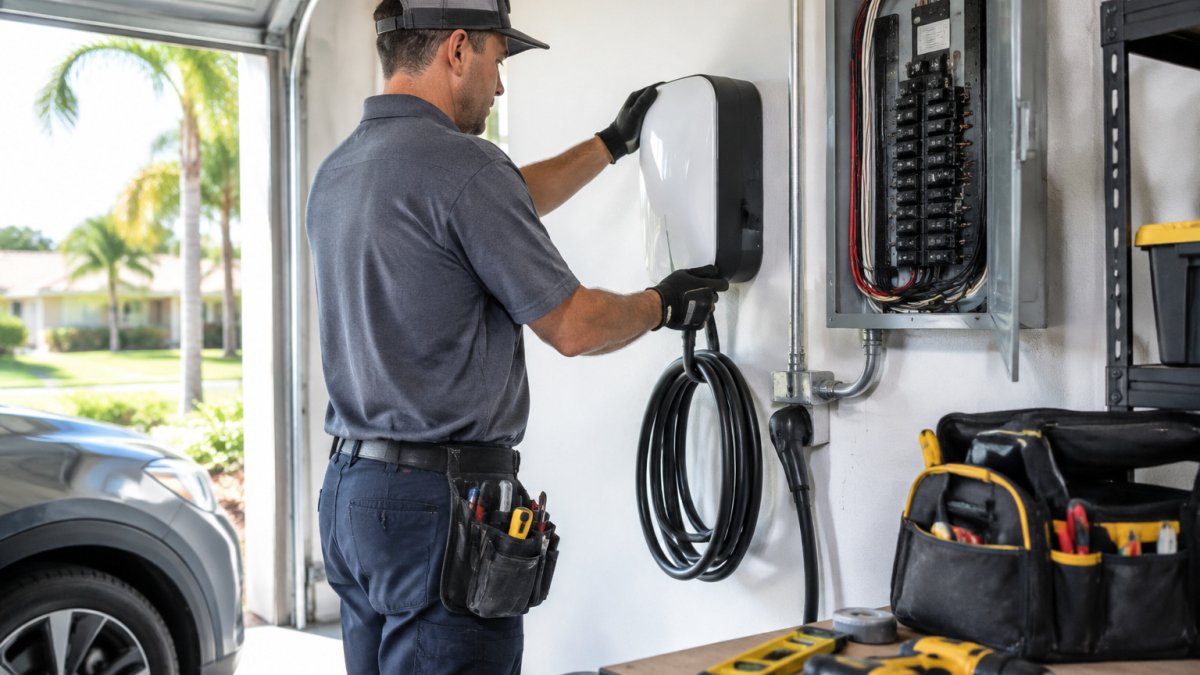
- Site assessment. The electrician evaluates the panel, measures the distance to the charging location, and confirms available capacity.
- Load calculation and charger selection. The amperage is matched to the panel and the vehicle.
- Permit. The permit is filed with the local authority before work starts.
- Circuit and wiring installation. A dedicated breaker and wire run are installed to code, including any panel work.
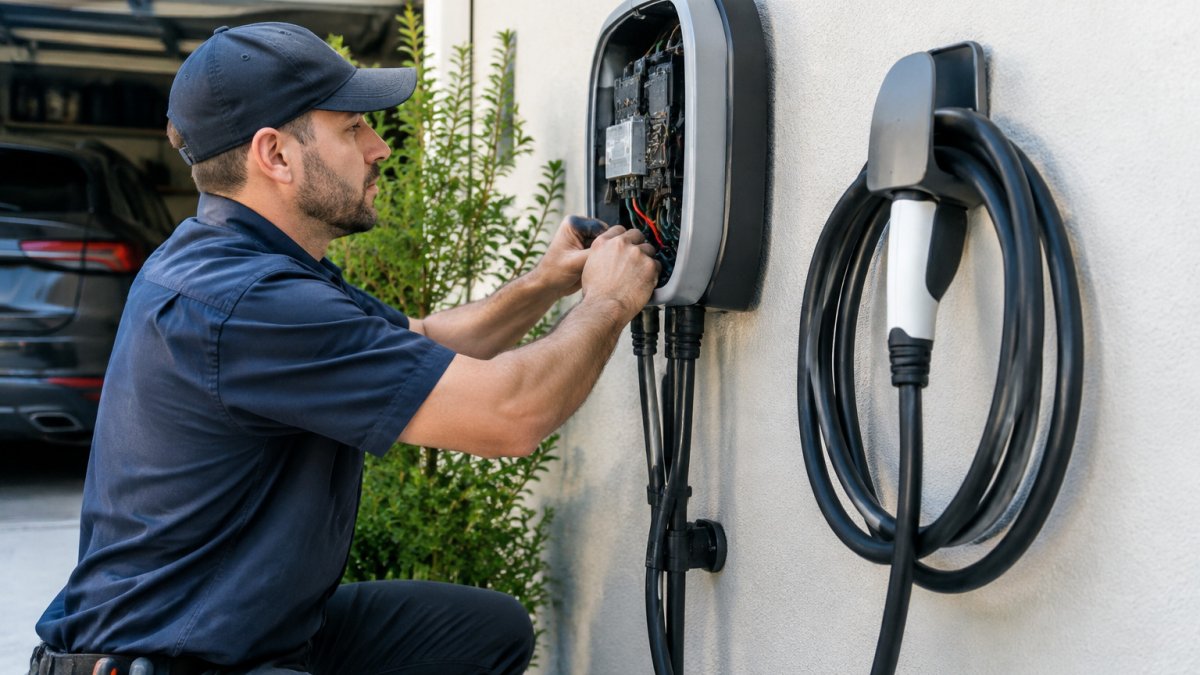
- Charger mounting. The unit is mounted at a suitable height and location, with the outlet or hardwire connection completed.
- Inspection. The local inspector verifies the work.
- Testing and handoff. The charger is energized, tested and set up for your vehicle.
On-site work time varies with the scope of the job, including any panel work or long wire run. Your electrician should walk you through the finished system and explain any settings, such as amperage limits or scheduling.
Florida Heat, Humidity and Storm Considerations for Outdoor Chargers
Florida's heat, humidity and storm season affect outdoor charger installations in specific ways. Choose a charger rated for outdoor use and install it in a weather-resistant enclosure. Pay attention to moisture at the connection point, since humidity and driving rain can accelerate corrosion if seals are inadequate.
Mounting height and placement matter in hurricane-prone areas. A charger installed away from flood-prone low spots and protected from direct wind-driven rain will generally hold up better. Ask your electrician how the unit will be sealed and whether a surge-protection device makes sense for your panel, since lightning and power fluctuations are a real concern during the rainy season.
Frequently Asked Questions
How much does it cost to install an EV charging station at home?
Costs vary with the charger, the amount of wiring needed, and the condition of your electrical panel. Pricing depends on the site assessment, the circuit run, and whether a panel upgrade is needed. Contact Clancy Electric for a free estimate that reflects your home and any permit or inspection fees.
Can you install an EV charger at home yourself?
Installing a Level 2 charger usually requires a dedicated circuit, electrical modifications, and a permit. The U.S. Department of Energy advises that installations comply with applicable codes, and the EPA notes that new-circuit work is best left to a professional. A licensed electrician can confirm your panel capacity and advise on the permit and inspection process.
Do I need a permit to install an EV charger at home in Lake Wales, Florida?
Permit requirements depend on local and state rules, and a new dedicated circuit is commonly treated as electrical work that requires one. A licensed contractor can confirm what the local building department requires for your property. Clancy Electric is licensed under EC13008459.
Can my existing electrical panel support a Level 2 EV charger?
Many homes have 240-volt service available, but whether your panel has room for a Level 2 charger depends on its rated capacity and the loads already running. An electrician can perform a load calculation to see whether you have enough headroom. If it does not, a panel upgrade or load management may be a practical alternative.
How long does home EV charger installation take?
Timing depends on the scope of the job, permit approval, and the inspection schedule. Ask Clancy Electric for an estimate of the expected timeline for your home.
Ready to see what a home charger would cost at your house? Clancy Electric, a locally owned and operated, fully licensed and insured team serving Polk County since 2015, offers free estimates on EV charger installations. We'll check your panel, recommend the right charger for your vehicle, and handle the permit and inspection. Book Your Home Charger Estimate with Clancy Electric