 how-to
Why Your Circuit Breakers Keep Tripping: Causes and Fixes
Last Updated: November 5, 2026
Quick Summary
Circuit breakers tripping is almost always caused by an overloaded circuit, a short circuit, or a ground fault. An overload trips after minutes of use, while a short circuit trips instantly and often with a pop. A ground fault trips when current escapes to the ground path, which is common near water.
- An overloaded circuit is the most common reason for circuit breakers tripping.
- Never replace a tripping breaker with a higher-rated one, which removes protection and lets wiring overheat.
- When resetting, push the breaker fully to OFF, then firmly to ON, and test one device at a time.
- A breaker that trips with nothing plugged in points to wiring or the breaker itself.
- Rain-related tripping usually means moisture is reaching an outdoor connection.
Table of Contents
- Common Reasons Circuit Breakers Keep Tripping
- Overloaded Circuits and Too Many Appliances
- Short Circuits and Ground Faults
- Faulty Appliances, Outlets, and Aging Breakers
- How to Reset a Tripped Breaker and Test One Device at a Time
- Is It Dangerous if a Circuit Breaker Keeps Tripping?
- Why Does My Breaker Keep Tripping With Nothing Plugged In?
- Why Does My Circuit Breaker Keep Tripping When It Rains?
- Why Do My Circuit Breakers Keep Tripping After Reset?
- Frequently Asked Questions
Common Reasons Circuit Breakers Keep Tripping
If you are dealing with circuit breakers tripping, the cause is almost always one of three things: an overloaded circuit, a short circuit, or a ground fault. A breaker is a safety switch, and it trips to stop current before wiring overheats. This is one of the most common electrical service calls, and the good news is that the pattern of the trip usually tells you which of the three you are dealing with.
Here is the short version. An overload trips after a while, when too many devices run at once. A short circuit trips instantly and often with a pop.
Knowing the difference saves you time and keeps you safe. Below, we walk through each cause, how to reset a breaker the right way, and when to stop and call a licensed electrician.
Overloaded Circuits and Too Many Appliances
An overloaded circuit is the most common reason for circuit breakers tripping.
The tell is timing. Overloads usually trip after minutes of use, not the instant you flip a switch. The breaker gets warm, then gives up.
Common overload patterns we find in Central Florida homes:
- Kitchen counter circuits running a microwave, toaster, and coffee maker together
- Garage outlets feeding a shop vac and a freezer on the same circuit
- Older homes with too few circuits for modern device counts
The fix is not a bigger breaker. Spread the load across circuits, unplug appliances you are not using, and if the panel is full, talk to us about adding capacity.
Short Circuits and Ground Faults
A short circuit is a hot wire touching a neutral wire or another hot wire.
A ground fault is similar but the current escapes to ground, often through water or a damaged cord.
Both are electrical faults you should not ignore. Signs to watch for:
- A burning smell near an outlet or switch
- Scorch marks or melted plastic
- A breaker that trips the moment you reset it
If you see any of these, stop resetting the breaker. The U.S. Consumer Product Safety Commission tracks home electrical fires each year, and faulty wiring is a leading contributor.
Faulty Appliances, Outlets, and Aging Breakers
Sometimes the breaker is fine and the problem is downstream.
Aging breakers are the quiet culprit. Breakers have a service life, and a worn breaker can trip under normal load or fail to trip when it should.
What we check first:
- Unplug every device on the circuit, then reset. If it holds, the appliance is the suspect.
- Inspect outlets and switches for heat, discoloration, or looseness.
- Look at the panel for rust, scorching, or breakers that feel loose.
- Confirm the breaker rating matches the wire size, not just the outlet.
Watch out: never replace a tripping breaker with a higher-rated one. That removes the protection and lets wiring overheat. The rating protects the wire, not the appliance.
How to Reset a Tripped Breaker and Test One Device at a Time
Resetting a tripped breaker is safe when you do it in the right order. Follow these steps.
- Identify the affected circuit. Check which rooms lost power and match them to the labels on your panel.
- Unplug appliances on that circuit. Everything, including small chargers.
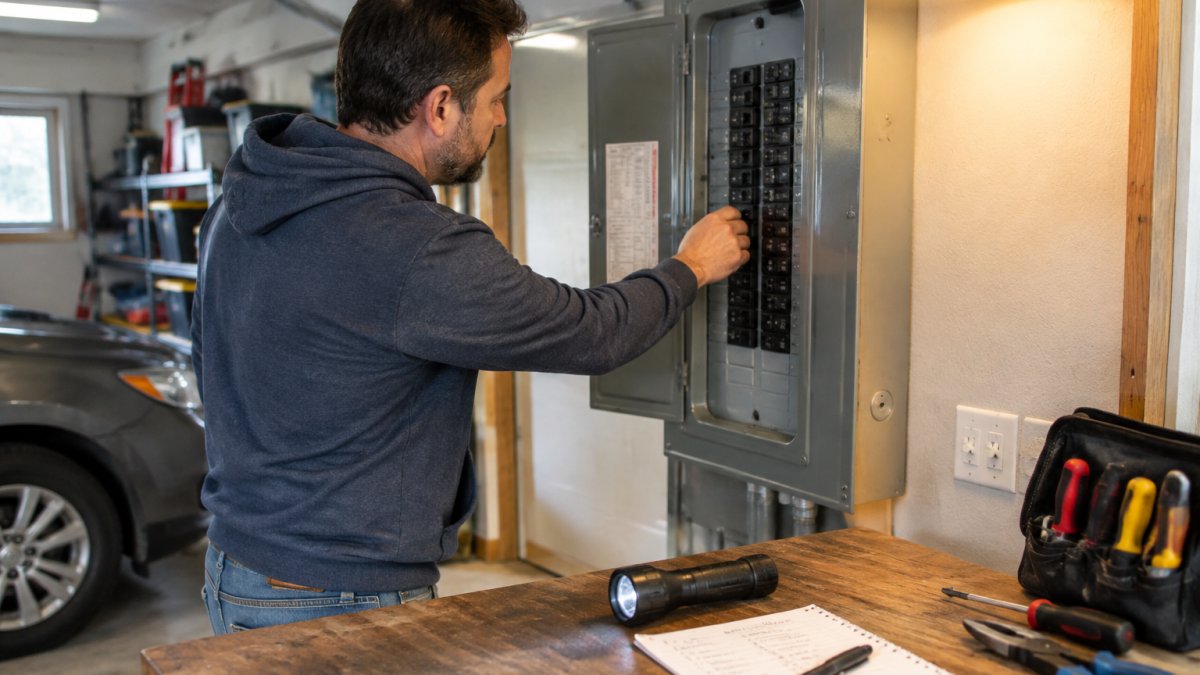
- Open the panel safely. Stand on a dry floor, keep one hand free, and use a flashlight.
- Push the breaker fully to OFF. Then push it firmly to ON. A breaker that will not stay on is telling you something.
- Test one device at a time. Plug in one appliance, run it, and watch. Add devices one by one.
- Note what trips it. The device that kills the circuit is your suspect.
If the breaker trips with nothing plugged in, skip ahead. That points to wiring, not appliances. The Electrical Safety Foundation International recommends a professional inspection for any circuit that trips repeatedly.
| Symptom | Likely Cause | What to Do |
|---|---|---|
| Trips after minutes of use | Overload | Spread the load, unplug extras |
| Trips instantly with a pop | Short circuit | Stop, call an electrician |
| Trips near water or outdoors | Ground fault | Check cords, test GFCI |
| Trips with nothing plugged in | Wiring or breaker fault | Professional inspection |
| Same breaker trips often | Worn breaker or loose connection | Have the panel checked |
Is It Dangerous if a Circuit Breaker Keeps Tripping?
Yes, is it dangerous if a circuit breaker keeps tripping is a fair question, and the answer is that repeated tripping is a warning, not a nuisance.
The real danger is what people do next. They hold the breaker on, tape it, or swap in a bigger one.
Treat these as stop signs:
- Burning smell anywhere near the panel
- Warm or discolored outlets
- A breaker that will not reset
- Repeated tripping after you reduced the load
Call a licensed electrician for any of them. Our team handles panel inspections and repairs across Polk County, and same-day service is available when possible.
Why Does My Breaker Keep Tripping With Nothing Plugged In?
A breaker that trips with nothing plugged in points to the wiring or the breaker itself, not your appliances.
This is the case where homeowner troubleshooting should stop. You cannot see a loose connection inside a wall, and opening boxes to hunt for it is how people get hurt.
What an electrician will do:
- Test the circuit with a meter to find where current is leaking
- Inspect outlets, switches, and fixtures on that circuit
- Check the breaker and panel connections for heat and tightness
- Trace damaged wiring and repair or replace the run
If your home has cloth-insulated wiring or an old fuse box, tell us when you call. Those systems need a closer look.
Why Does My Circuit Breaker Keep Tripping When It Rains?
Rain-related tripping almost always means moisture is reaching a connection. The usual suspects are outdoor outlets, landscape lighting, pool equipment, and any splice or box that is not sealed properly.
What to check after a storm:
- Outdoor receptacles and their covers
- Pool pumps, timers, and lighting transformers
- Sprinkler and landscape wiring
- Any conduit or box that takes on water
GFCI breakers and outlets are designed to detect ground faults, which is why they trip first. If an outdoor circuit trips every time it rains, the fix is sealing or replacing the damaged connection, not resetting it each time.
Why Do My Circuit Breakers Keep Tripping After Reset?
If the breaker trips again right after you reset it, the fault never went away. The circuit is still overloaded, still shorted, or still grounded.
Three patterns to know:
- Trips instantly: short circuit or ground fault. Stop and call.
- Trips after a few minutes: overload or a failing breaker. Reduce the load and watch.
- Trips randomly, days apart: intermittent fault, often a loose connection or moisture.
Intermittent tripping is the hardest to chase and the most worth chasing. A loose connection that trips once a week can overheat between trips.
Clancy Electric is licensed, insured, and has served Polk County since 2015 (License #: EC13008459).
Frequently Asked Questions
How many times can a breaker trip before it breaks?
A standard breaker is built to trip many times over its service life, but repeated tripping under fault conditions wears the internal mechanism. If a breaker trips several times in a short period, or trips again immediately after you reset it, stop resetting it. Repeated tripping points to an unresolved electrical fault, and continuing to reset it stresses both the breaker and the wiring. Have a licensed electrician inspect the circuit before using it again.
Can a tripped breaker still be in the on position?
Yes. Some breakers trip internally and leave the handle looking on or sitting in a middle position between on and off. Before assuming a circuit is dead, switch the breaker fully to off, then firmly back to on. If the handle feels loose or will not stay in the on position, the breaker itself may be worn or faulty. A breaker that will not reset and hold should be evaluated by a licensed electrician rather than forced.
Does a breaker need to be replaced if it keeps tripping?
Not always. Most repeated tripping comes from the circuit, not the breaker: an overloaded circuit, a faulty appliance, a loose connection, or damaged wiring. Replacing the breaker without finding the cause just moves the problem. An electrician will test the circuit, inspect the panel for overheating or burning smell, and check the breaker rating against the wire size. Only then can you tell whether the breaker is worn or the fault lies elsewhere.
What should I do if a breaker trips again after I reset it?
Unplug everything on that circuit and reset the breaker once. If it holds with nothing connected, plug devices back in one at a time until it trips, which identifies the faulty appliance. If it trips again with nothing plugged in, stop and call a licensed electrician. Never hold a breaker on, tape it in place, or swap in a higher-rated breaker. Those shortcuts bypass the protection and create a real fire risk.
A breaker that keeps tripping is asking you a question, and the answer is rarely "reset it again." If you have unplugged the load and it still trips, it is time for a licensed electrician to trace the fault, check the panel, and make the repair right the first time. Clancy Electric offers free estimates, same-day service when available, and a team that is fully licensed, trained, and insured. Get started with Clancy Electric and get your power back to normal, safely.
